NWO-VENI “The more the merrier? The role of step-grandparens in complex family networks”
- University of Groningen, The Netherlands
- Interuniversity Center for Social Science Theory and Methodology (ICS)
In the 1990s, the Netherlands experienced a peak in divorces. Now, 30 years later, divorced parents have often found new partners, and their adult children have established their own families. As a result, families can now consist of four biological grandparents and additional step-grandparents, potentially resulting in “eight-grandparent families”. By utilizing registers that document the kinship networks of the Dutch population, it is examined to what extent having step-grandparents can be a benefit or a burden for the younger generations. Additionally, new data is collected about step-grandparent relationships to understand under what conditions relationships with step-grandparents can thrive.
DFG-Walter Benjamin “Changes in the family network after parental divorce”
- University of Cologne, Germany
- Netherlands Interdisciplinary Demographic Institute (NIDI)
This research project was funded by Walter Benjamin funding of the German Research Foundation (DFG, reference: 502057823). As a POPNET fellow, I analyzed complex kinship structures using the family layer of the Dutch population-scale social network.
Publications:
de Bel, V., Bokányi, E., Hank, K., & Leopold, T. (2024). A parallel kinship universe? Using Dutch kinship network data to replicate Kolk et al.’s (2023) demographic account of kinship networks in Sweden. https://doi.org/10.31235/osf.io/3k6nq [pre-print]
Steinbach, A., Augustijn, L., & de Bel, V. (2024). The quality of the stepfather–child relationship in sole and joint physical custody. Family Relations, March, 1–15. https://doi.org/10.1111/fare.13056
Senior Researcher NetResilience
- University of Turku, Finland
- INVEST flagship
- Netherlands Interdisciplinary Demographic Institute (NIDI)
2022-2023: NetResilience studies social networks, fertility and well-being in aging populations. I studied how contact between adult children and their parents is associated with adult children’s entry into parenthood, and whether this varies by level of education and gender. The paper is not published yet.
Postdoc project “CH-X”
- Swiss Centre of Expertise in Life Course Research (LIVES)
- University of Geneva, Switzerland
2020-2022: I have been working on a project about the personal networks of young adults in Switzerland. The aim of this project was to study which social capital matters for young adults’ educational attainment and their entrance to the labour market. Personal network data have been collected among more than 10,000 young adults and I was in charge of checking and cleaning the incoming 2020 data.
PostDoc publications:
Vacchiano, M., de Bel, V., & Widmer, E. (2025). Being Your Own Boss: Network Determinants of Young People’s Orientations Towards Self-Employment. Social Indicators Research, 176(1), 195–217. https://doi.org/10.1007/s11205-024-03443-3
de Bel, V., & Widmer, E. D. (2024). Zonder wrijving geen glans? Mens & Maatschappij, 99(4), 389–393. https://doi.org/10.5117/MEM2024.4.006.BEL
de Bel, V., & Widmer, E. D. (2024). Positive, negative, and ambivalent dyads and triads with family and friends: A personal network study on how they are associated with young adults’ well-being. Social Networks, 78, 184–202. https://doi.org/10.1016/j.socnet.2024.02.004
Giradin, M., Widmer, E., Ganjour, O., Zufferey, M., de Bel, V., Huri, S., & Tettamanti, M. (2024). Une refamilialisation du social dans la crise sanitaire de COVID-19 ? Éléments d’interprétation issus d’une revue de presse de mars à juin 2020 dans plusieurs pays européens. In Sociograph – Sociological Research Studies (Vol. 65). [download]
de Bel, V. and Widmer, E.D. (2021). Nuclear Family. In The Blackwell Encyclopedia of Sociology, G. Ritzer (Ed.). https://doi.org/10.1002/9781405165518.wbeos1767
Widmer, E. D., de Bel, V., Ganjour, O., Girardin, M., & Zufferey, M.-E. (2020). Dynamiques familiales et COVID-19: Réactions à la période de confinement. In F. Gamba, M. Nardone, T. Ricciardi, & S. Cattacin (Eds.), COVID-19: Le regard des sciences social (pp. 159–177). Seismo. https://doi.org/10.33058/seismo.20735 [Original publication in French, translations published in German and Italian]
NWO-Talent Grant “The ripple effect in family networks. Relational structures and well-being in divorced and non-divorced families”
- PhD research
- University of Groningen, the Netherlands
- Interuniversity Center for Social Science Theory and Methodology (ICS)
2015-2019: Why do some families fare better than others after parental divorce in terms of relationships quality and family well-being? Parental divorce not only affects the nuclear family, i.e., parents and children, but also affects extended family members, i.e., grandparents and aunts/uncles, and their relationships with the nuclear family. At the same time, extended family members can be an important source of support for nuclear family members after parental divorce. My thesis contains a number of studies on family network data from datasets collected by other researchers, as well as the first study on Lifelines Family Ties for which we collected multi-actor family network data among children, parents, grandparents, aunts/uncles and potential stepfamily members. My PhD research was funded with a talent grant from the Dutch Research Council (NWO, reference: 406-15-191
PhD publications:
de Bel, V., & Van Gasse, D. (2020). Knotting the safety net. A multi-actor family network approach in divorce research. In D. Mortelmans (Ed.), Divorce in Europe. New insights in trends, causes and consequences of relation break-ups. (1st ed., p. 357). Cham, Switzerland: Springer. https://doi.org/10.1007/978-3-030-25838-2
de Bel, V., Kalmijn, M., & van Duijn, M. A. J. (2019). Balance in family triads: How intergenerational relationships affect the adult sibling relationship. Journal of Family Issues, 40(18), 2707–2727. https://doi.org/10.1177/0192513X19860181
de Bel, V., Snijders, T. A. B., & Widmer, E. D. (2021). Modelling ambivalent triads in family research. Social Science Research, 98(102577). https://doi.org/10.1016/j.ssresearch.2021.102577
de Bel, V., Potarca, G., & van Duijn, M. (2025). “Fault Lines” and Substitution in the Family Network: Contact Between Children, Mothers, Fathers, and Maternal and Paternal Grandparents in Divorced and Non‐Divorced Families. Personal Relationships, 32(2), 1–32. https://doi.org/10.1111/pere.70017
de Bel, V., & van Duijn, M. A. J. (2024). Collecting multi-actor family network data. Research Data Journal for the Humanities and Social Sciences, 1–14. https://doi.org/10.1163/24523666-bja10040
de Bel, V. (2023). Multi-functional ties and well-being in family networks before and after parental divorce. Social Sciences, 12(11), 586. https://doi.org/10.3390/socsci12110586
de Bel, V. (2020). The ripple effect in family networks. Relational structures and well-being in divorced and non-divorced families [University of Groningen]. https://doi.org/10.33612/diss.126812050
de Bel, V. (2020). Kringen in de vijver van het familienetwerk. Sociologie Magazine, 28(3), 30–31.
If you wish to receive a free a hard-copy version of my thesis, don’t hesitate to contact me. You can download the digital version of my thesis using this link: https://doi.org/10.33612/diss.126812050
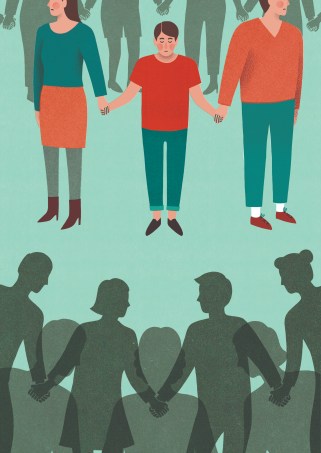
The cover illustration of my thesis is designed by Lize Prins
 Vera de Bel